Proxy wars
By Jude Lange
Speaker Notes:
HI! My name is Jude and this is my presentation on proxy wars. IN this presentation we will explore the historical proxy wars as well as a modern proxy war still waging to this day. We will compare and contrast proxy wars and present on their importance and what they show historically.
Defining a proxy war
A proxy war is a method of warring against another state without you yourself becoming involved directly with the opposing state by supporting other countries who are fighting in ideals you believe in. resources are typically provided like ammo forces and strategic support.
- Indirect combat
- Foreign funding/weapons
- Rivalry between superpowers
Speaker Notes:
A proxy war is a method of warring against another state without you yourself becoming involved directly with the opposing state by supporting other countries who are fighting in ideals you believe in. resources are typically provided like ammo forces and strategic support. The specific element of no direct involvement is absolutely crucial for a proxy war as that's what directly makes it a proxy war.
Visual model
Speaker Notes:
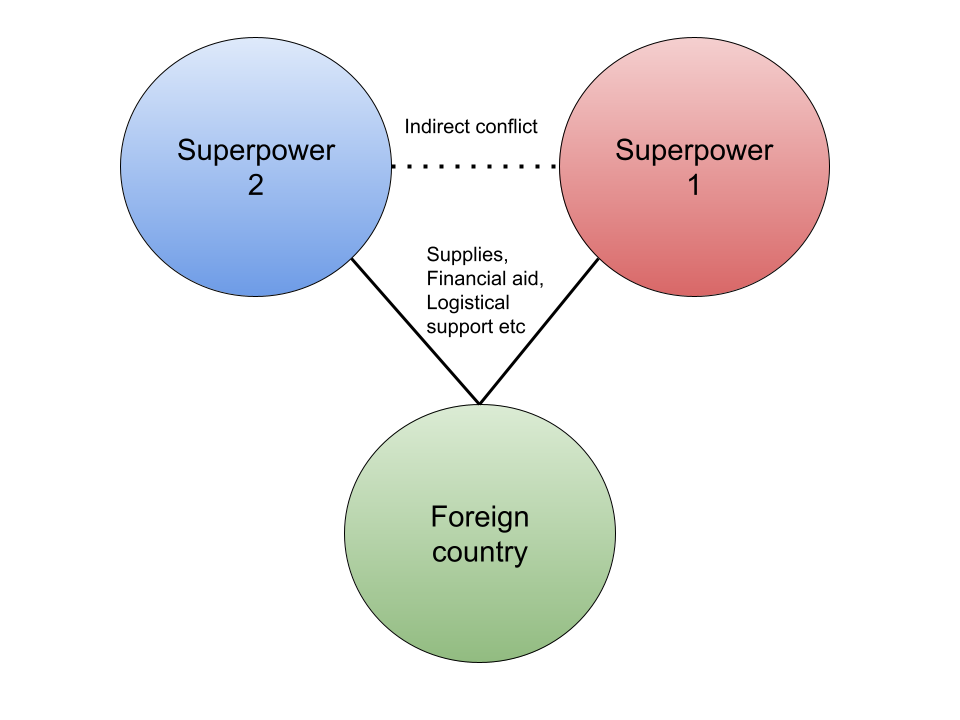
This model shows a proxy war in a graphical format. The blue and red bubbles represent global superpowers like the U.S or the Soviet union. The dashed line shows they are fighting but its indirect. The solid lines leading to the green foreign country show their direct support to the country depending upon the side. As you can see, the superpowers are fighting via proxy as the definition states.
Afghan timeline
01 Soviets intervene
The soviet union helped support afghans failing communist government.
02 Power Reactions
The United States, Pakistan, and Saudi Arabia funneled billions of dollars.
03 Combat
The soviets controlled the cities while the Mujahideen used guerilla warfare.
04 Turning point
The U.S began to supply the rebels with stinger missiles.
05 Aftermath
Soviets withdrew in defeat in 1989.
Speaker Notes:
The afghan war began with the soviet union helping to support afghanistan. As a reaction to this the united states pakistan and saudi arabia sent billions of dollars to support the rebels. Through this war guerrilla warfare was used to fight against the soviet controlled cities. The war began to turn when the U.S started to supply rebels with stinger missiles allowing them to shoot down helicopters. And finally in 1989, the soviet union withdrew in defeat. This war matches my definition as the powers did not fight directly and were mostly supplying missiles ammo etc to the foreign country.
Outside involvement
- U.S: The united states sent stinger missiles to the rebels without becoming directly involved.
- Soviet Union: Soviet union supported the new government that was instated.
Speaker Notes:
Through this war, the most two major outside countries involved were the U.S and the soviet union. The U.S sent a variety of supplies to the rebels including stinger missiles. They got involved in order to prevent afghanistan from remaining a communist state. The soviet union supported the current communist afghanistan government which was crumbling. Similarly to the U.S, the Soviet Union supplied the government but unlike the U.S they got involved physically in the country.
Korean timeline
01 North korea Invades
North korea invaded south korea crossing the 38th parallel.
02 Power Reactions
The soviet union sent supplies while china sent soldiers the U.N supported south korea.
03 Combat
The North neared victory until the U.S intervened to push towards china and china pushed back.
04 Involvement
The soviet union and china prevented north korea's defeat and the U.S did not want to start WW3.
05 Aftermath
War ended in a fragile ceasefire armistice.
Speaker Notes:
The Korean war began when North korea Invaded south korea, crossing the 38th parallel. In response the Soviet union sent supplies to north korea while china sent soldiers. The U.N backed by the U.S supported south korea with supplies. The combat in korea was much different than how it went in afghanistan the combat was similar to a seesaw as when one neared victory they were pushed back until near defeat and then vice versa. The soviet union and china prevented North Korea from total defeat and The U.S prevented south Korea's total defeat. The U.S specifically did not want to start WW3. In the end, the war ended with a fragile ceasefire. This war matched my definition as well with mostly just supply support from the superpowers and almost exclusively U.S soldiers on the ground.
Outside involvement
- U.S: Fought within the borders of korea helping south korea push back against north koreans.
- Soviet Union: Sent supplies to north korea to help fight against south korea.
Speaker Notes:
Through this war as well, the most two major outside countries involved were the U.S and the soviet union. The U.S. intervened to stop the spread of communism, while the Soviets intervened to maintain their global influence without triggering World War 3. The effect was a permanently divided peninsula with massive casualties.
How were they similar/different?
- Afghan: Soviet union lost, Soviet union sent troops, Guerilla warfare.
- Both: Superpowers did not directly fight each other. Both had a communist vs non communist side.
- Korea: Conflict had no winner, U.S sent troops, “Seesaw” warfare.
Speaker Notes:
The afghan and the Korean wars were similar and different in a lot of ways In afghanistan the soviet union lost while korea ended in a ceasefire. They both were proxy wars with no direct fighting between the superpowers and they were both commies vs non commies. In the korean war the U.S sent troops while on the other hand in Afghanistan, the Soviet union was mostly sending troops. In afghanastan guerrilla warfare was implemented while Korea was more like a seesaw.
Syrian war
- Syrian government: THe syrian government led by President Bashar al-Assad. Kurdish forces Trying to overthrow the syrian government.
- Russia/Iran: Russia and Iran are intervening for the syrian government.
- U.S, Turkey, Saudi Arabia: These governments are fighting for the rebels helping them overthrow the government.
Speaker Notes:
The Syrian war is still raging on today with two major sides. The syrian government led by President Bashar al-Assad and the Kurdish forces attempting to overthrow said government. Russia and Iran are directly supporting the syrian government while the U.S, Turkey, and Saudi Arabia are supporting the rebel and Kurdish forces.
Proxy war traits
- Supplies: Both sides are mostly just supplying supplies like ammunition tanks money etc.
- No direct conflict: The powers do whatever they can to avoid direct conflict.
Speaker Notes:
This war is a proxy war and is supported by my definition that was stated previously. Both sides are mostly aiding each other through supplies like ammunition, Tanks, Financial aid, etc. And there is no direct conflict even though sometimes they are working within the same airspace special care is taken not to shoot at each other. Both of these traits were also exemplified previously with the last two proxy wars covered showing that cold war themes continue today. Once again these conflicts are happening in order for each party to protect its ideals and to stop the spread of each other. Which has profound impacts arose the world.
Cold war pattern
The cold war pattern continues to this day. Global superpowers still use local civil wars to compete for dominance without risking a direct war with each other.
Speaker Notes:
The cold war patterns of the Past still repeat today and are used to support either sides goals. Superpowers still fight indirectly in order to prevent all out war against each other which would be bad for both sides and the whole world in general. So instead and to this day they fight indirectly to impose their goals and ideals against one another to keep each other's power in check and make sure that they remain on top or at least try to.
What proxy wars reveal about global competition
Proxy wars show that it's better to fight via proxy and not directly. Even at the cost of human life.
Speaker Notes:
Overall, Proxy war have a profound impact across the globe affecting smaller countries being fought over and the global superpowers themselves, The global superpowers spread their influence while those fighting in the wars lose their lives and close ones lives. The Proxy war predominantly affect the Smaller countries being fought over and have profound impacts on their economy and geography.
Sources
- Baugh, Sue. “Proxy War | Armed Conflict.” Encyclopædia Britannica, 2019, www.britannica.com/topic/proxy-war.
- The Editors of Encyclopedia Britannica. “Afghan War | History & Facts.” Encyclopædia Britannica, 14 Nov. 2018, www.britannica.com/event/Afghan-War.
- Office of the Historian. “The Soviet Invasion of Afghanistan and the U.S. Response, 1978–1980.” State.gov, 2024, history.state.gov/milestones/1977-1980/soviet-invasion-afghanistan.
- Wikipedia Contributors. “Soviet–Afghan War.” Wikipedia, Wikimedia Foundation, 18 Dec. 2018, en.wikipedia.org/wiki/Soviet%E2%80%93Afghan_War.
- “Korean War - Causes, Timeline & Veterans | HISTORY.” HISTORY, 9 Nov. 2009, www.history.com/articles/korean-war.
- Dwight D. Eisenhower Presidential Library. “The Korean War | Eisenhower Presidential Library.” Eisenhowerlibrary.gov, National Archives, 8 Nov. 2022, www.eisenhowerlibrary.gov/research/online-documents/korean-war.
- Millett, Allan R. “Korean War.” Encyclopaedia Britannica, Britannica, 29 May 2019, www.britannica.com/event/Korean-War.
- Center for Preventive Action. “Conflict in Syria.” Global Conflict Tracker, Council on Foreign Relations, 14 May 2025, www.cfr.org/global-conflict-tracker/conflict/conflict-syria.
- BBC. “Why Has the Syrian War Lasted 12 Years?” BBC News, 2 May 2023, www.bbc.com/news/world-middle-east-35806229.